RKMVERI
Academic Policies (2026–2027)
Registrar’s Office,
RKMVERI
Last updated: April 26, 2026
This academic policies document explains the Ramakrishna Mission
Vivekananda Educational and Research Institute (RKMVERI) academic policies
following University Grants Commission (UGC) guidelines and National
Education Policy 2020 (NEP 2020) of Government of
India.
The departments/schools/divisions/faculty centres are required to
promptly initiate the implementation of the following revised grading
system for all incoming batches admitted from the July 2023 session
onwards.
Every academic session of the university will start on
July 5 of every year and end on July 4 next year.
(a) Each academic year will be conducted for at least 192
working days excluding examination and admission/registration
days. Therefore it is recommended that each semester has
approximately 96 teaching days, excluding examinations and holidays.
This corresponds to about 16 weeks of teaching or about 19 weeks
including holidays, class tests and mid-term/final examinations.
Reference: UGC
Regulations on Minimum Qualification for appointment of Teachers and
Other Academic Staff in Universities and Colleges and Measures for the
Maintenance of Standards in Higher Education 2018 (Section 14. Teaching
Days).
(b) RKMVERI follows six working
days week from Monday to Saturday.
(c) The office hours on each working day of Belur Math, Narendrapur
and Coimbatore campuses are 9:30 am – 5:30 pm and of
Ranchi campus are 9:00 am – 5:00 pm.
(d) There may be extra classes by teachers and extra teaching days by
departments to satisfy the credits, hours, days and weeks requirements
mentioned above.
(e) According to Rehabilitation Council of India (rci),
the rci regulated programmes will
be conducted for at least 200 working days each year exclusive of the
period of examination and admission. The rci regulated faculties shall
work for a minimum of thirty six hours in a week (five or six days),
during which physical presence in the institution of all the teachers
and student teachers is necessary to ensure their availability for
advice, guidance, dialogue and consultation as and when needed.
It is recommended that the classes should commence by Monday of
last full week of July in odd semesters and first working day of January
in even semesters (i.e. latest by 26 July/earliest by 1
January).
It is recommended that the examinations should end by Saturday of
first week of December in odd semesters and Saturday of first week of
May in even semesters (i.e. latest by 6 December/6 May).
The convocation of the university will be held in the month of
July. The convocation ceremony of Belur Math and Narendrapur campuses
will be held on July 4 every year except in unavoidable
circumstances. The convocation ceremony of Ranchi and Coimbatore
campuses will be held on subsequent weeks of July.
The prior week of any semester before 1st Monday
is for the course/research registration.
Last day for course/research registration is 1st Monday
of the semester.
Last date for late course/research registration is 2nd
Monday of the semester.
Last date for adding extra credits and other credit adjustment is
2nd Monday of the semester.
Last date for dropping credits is 3rd Monday of the
semester. The student needs to resubmit the revised course/research
registration.
Late course/research registration and late fees submission will incur
late fines.
Last day for fees submission is 1st Saturday of the
semester.
Last day for fees submission with fines is 2nd Saturday
of the semester.
If any of the aforementioned days are holidays then next working
day will be applicable.
There will be no examination leave and no examination preparation
inter-gaps in the examination schedule, except for scheduled holidays
and weekends.
It is recommended that the final evaluation of the term
projects, seminars, presentations, papers, reports, field works, etc.,
should be completed before the commencement of final examinations
in-semester for the sake of prompt semester evaluation.
The final evaluation results by the course instructors should be
declared within one month after the written end-semester examinations,
or 15th January for odd semester and 15th June for even semester,
whichever is earlier. These evaluations will be submitted to HOD
who in turn will submit to CoE later.
The re-exam, if any, will be held before the commencement
of next academic semester. The re-exam will be conducted by the
course instructors. The course instructor needs to convey the necessary
information to the concerned students at least two weeks before the
re-exam.
The national holidays are mandatory since RKMVERI is a central
institute, declared by Government of India as deemed university under
section 3 of UGC Act, 1956. Other holidays,
such as state holidays and institute holidays, are optional. The list of
holidays will be prepared by office of registrar following department of
personnel and training recommendations and will be ratified by executive
council (ec).
Reference: dopt, goi
gazetted holidays, 2024
There are 14 goi gazetted national holidays
with a provision for 3 state holidays by the state coordination
committees and 2 employee holidays according to DOPT.
RKMVERI allows
multidisciplinary programmes.
RKMVERI allows lateral entry
and lateral exits.
RKMVERI allows abc
credit recognition and transfer.
RKMVERI admits students
through cuet as per UGC
guidelines.
For the RKMVERI programmes, which do
not have cuet at present, the
departments can either evaluate eligibility on the basis of other but
related subject test scores or have separate entrance examinations and
subsequent viva-voce.́
The various departments should ensure to advertise about
admissions, admission eligibility criteria, multidisciplinarity, lateral
entry and exit policy, etc. in due time by advertising
properly.
The various departments can hold entrance examinations for
lateral entry students.
Every undergraduate and postgraduate student has to
register in every semester of every academic session to be eligible for
requirement of award of the degrees. This includes, all diploma,
bachelor, master and PhD degree students with no exceptions. This also
includes students who are only doing projects. internships, field work
and/or research.
All course/research registrations each semester are to be
submitted to head of department. The head of department will submit the
relevant course/research credits registration to the registrar later.
The registration must be completed in the pre-registration week or the
first day of the semester without late registration fees, or on the last
day of registration with the late registration fees.
All degree programme students, including PhD research
scholars, have to pay applicable semester fees before due dates every
semester. Failing this, the students will have to pay the prescribed
fines.
If a student fails to register or fails to pay semester
fees for two consecutive semesters then his programme may be deemed to
be discontinued.
All the core courses, electives, thesis, projects, seminars,
value added courses, internships, etc., for credits have to be mentioned
in the course registration form by the student.
Online courses, such as nptel courses, swayam courses, external
courses (offered by institutes with MoU with RKMVERI), and special guest
courses, once registered cannot be dropped.
All registered courses will be mentioned in the progress report
of a student.
UGC rules for workload are as
follows.
15.1The workload of the teachers in full employment should not be
less than forty hours a week for thirty working weeks (one hundred and
eighty teaching days) in an academic year. It should be necessary for
the teacher to be available for at least five hours daily in the
university/college. Teachers shall devote at least two hours per day for
mentoring of students (minimum fifteen students per coordinator) for
community development/extra- curricular Activities/library
consultation/research in case of undergraduate courses and/or at least
two hours per day for research in case of postgraduate courses, for
which the necessary space and infrastructure shall be provided by the
university/college. The direct teaching-learning workload should be as
follows:
Assistant Professor — 16 hours per week and
Associate Professor/Professor — 14 hours per week.
15.2Professors/ Associate Professors/ Assistant Professors involved
in administration/ extension work can devote two hours per week from the
teaching and learning hours (i.e. teaching-learning workload will be
reduced by two hours).
The instructor of any course should explain to the
students the following in the first day of instruction.
Course description and information,
Syllabus,
Text books and references,
Course outcome, knowledge acquired and skills gained,
Attendance policy,
Examination and tests policy of the course,
Assignments policy of the course,
Project/term paper/term reports/seminars/field work/etc. in the
course,
Evaluation and grading policy of the course and weightages of
different components for evaluation, and,
Weekly schedule of the study material covered.
It is recommended that the board of studies (BOS)
should periodically review syllabi, course structure and evaluation
methods, at least every two years.
Reference: UGC
Regulations on Minimum Qualification for appointment of Teachers and
Other Academic Staff in Universities and Colleges and Measures for the
Maintenance of Standards in Higher Education 2018 (Section 15.
Workload).
Every department should do a
course/instructor/programme/institute feedback before end-semester
examination every semester.
A one year degree programme will have minimum 40
(subject courses) + 2 (value added courses) credits.
Any multi-year degree programme will similarly have the total credits
such that per year credits, i.e. total credits divided by years, are
minimum 40+2 credits.
The department may prescribe more than minimum credit (\(>\)40+2) per annum on an average)
recommended above depending on the course/discipline/subject
requirement.
It is mandatory that one credit is 15 hours of lectures/tutorials
by course instructors or teaching assistants or 30 hours of
supervised laboratory, projects, field work, internship or 15
hours of thesis guidance. In other words, one credit per course
corresponds to one theory or two practicum contact hour of the course
per week for sixteen weeks in an academic semester.
The credits of a course pertains to student contact hours
(and not faculty teaching hours) per student.
Each credit hour for thesis, project, laboratory, field work or
internship, amounts to 2 hours of supervised academic work.
Unsupervised laboratory, learning, project, field work,
internship, etc., do not count for credits.
The recognized online, external and special guest courses have
their specified credits independent of RKMVERI rules as determined by
the HOD/BOS.
Undergraduate and postgraduate degree projects, including
masters’ thesis and internships, will not exceed 8 credits per
semester. Also, for example, 8 credits must include at least 4
hours for supervised project/research/practicum and at least 12 hours of
unsupervised work per week by the student.
UGC has recommended
ability/skill enhancement and value added courses for each degree
programme. The value added courses should be as per guidelines of UGC.
Every degree programme should have 4-6 credits for such courses
per year. These may include Professional Ethics,
Professional Methodology and Professional Writing and
Presentation. Each department should ensure such value added
courses for the students.
PhD thesis credits will not exceed 18 credits per
semester which must include sufficient supervised guidance.
This corresponds to \(6 \times 6 = 36\)
hours of active research in a week.
A PhD programme shall have minimum 12 credits of course
work according to UGC guidelines. It is
recommended to have 12–16 credits of pre-registration course work for
PhD students.
UGC has made compulsory a two
credit value added course for awareness about publication ethics and
publication misconducts entitles “Research and Publication Ethics” for
all PhD students for pre-registration course work. Each
department has to ensure a 2-credit the Research and Publication
Ethics course for their PhD students in their first year.
UGC has mandate a course on
Research Methodology. According to UGC
this course should cover areas such as quantitative methods, qualitative
methods, computer applications, research ethics, literature survey,
literature searching, literature review, statistical data analysis,
interpretation, error analysis, hypothesis testing, fieldwork
methodology, etc. Each department has to ensure a 2-credit
Research Methodology course for their PhD students in their
first year.
The research work in a PhD programme will only commence
when the student has cleared the course work with a minimum of 5.5
CGPA as recommended by UGC. A PhD student is
allowed research credit registration every semester only after
successful completion of his pre-registration course work.
Full attendance in any course is required
ideally. In exceptional circumstance leave may be granted on
prior application of leave by the student or the guardian.
In case a student is absent or is on leave, it is the
responsibility of the student to be up-to-date about any material
covered in the class and any class announcements by the
instructor/teachers/TAs.
PhD students are required to have full attendance in the
campus/department for six hours, six days a week whenever the institute
is open. In exceptional or prescribed circumstances, they will
be allowed leave on intimation.
If a student is absent during any surprise quiz, announced quiz,
class assignment, seminar, presentation or any such class activity then
the course instructor may not reschedule the said class
activity.
A student will be disallowed to take final exams if his aggregate
attendance in lectures, tutorials, seminars, practicums, field work
etc., which a student shall be required to attend in a semester for
eligibility to appear at the examination, falls below 75% and will have
to repeat the semester.
According to UGC, the minimum number of
lectures, tutorials, seminars and practicums, which a student shall be
required to attend for eligibility to appear at the examination, shall
be prescribed by the university, which ordinarily shall not be less than
75% of the total number of lectures, tutorials, seminars, practicums,
and any other prescribed requirements.
Reference: UGC
(Minimum Standards of Instruction for the Grant of the Master’s Degree
through Formal Education) Regulations, 2003
A student will be disallowed to take final exams for rci
regulated courses as per rci guidelines.
According to rci, in rci
regulated programmes, the minimum attendance of Student-Teachers shall
have to be 80% for all course work, 90% for all practicum, and 100% for
school internship (maximum 5% attendance may be condoned by the head of
institution on genuine grounds in special cases).
In exceptional circumstances such as official participations on
behalf of university in sports meet, educational meets, ncc
activities, nss public assignments,
inter-university festivals, cultural ambassador, other activates
approved by the vice-chancellor, prescribed medical leave the student is
deemed to have attended for the said period.
If a defaulting student has excellent academic performance, had
prolonged serious illness, is with disabilities, etc., then the
examination committee may consider the condonement of absence on the
formal appeal of the student showing the cause of absence and
remorse.
In no case this condonement will exceed 5% decided. Moreover, the
condonement shall be accompanied by a suitable fine with a promise to
meet the deficiency of attendance in the next semester. Both of these
will be decided by the Controller of Examination on the recommendation
of the examination committee.
A value added course instructor may assign weightage to
attendance in course evaluation.
The relative grading and absolute grading adopted by RKMVERI based on guidelines by
UGC is as follows. \(\mu\) is the average of the marks scored by
the students and \(\sigma\) is the
standard deviation.
The estimated average CGPA should be 6.0
corresponding to grade \(\texttt{B}\).
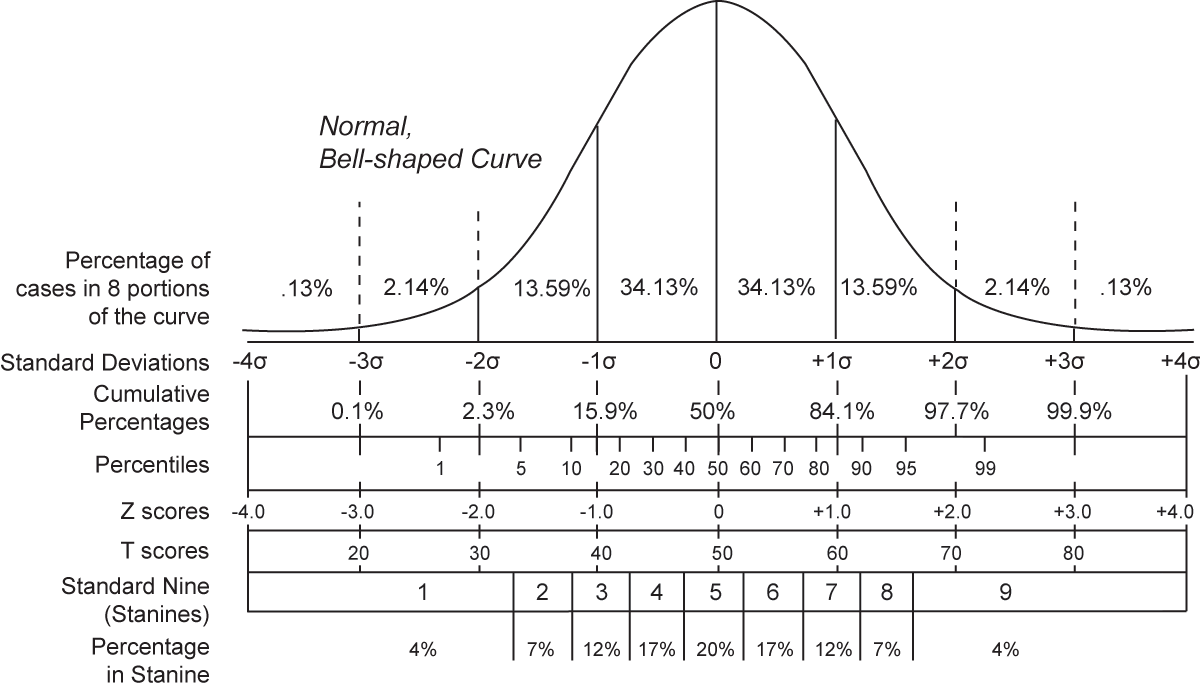 Reference: Normal
distribution and scales
Reference: Normal
distribution and scales
The reference table for absolute grading to be followed is given
below.
| Gr. |
Desc. |
Gr. |
Rec. |
Rec. |
|
|
Pts. |
Min. |
Marks |
|
|
|
Stud. |
(Abs. grading) |
| (a) |
(b) |
(c) |
(d) |
(e) |
| \(\textrm{O}^\texttt{+}\) |
Superlative |
10 |
44 |
100% |
| O |
Outstanding |
10 |
15 |
90% – 99.9% |
| \(\textrm{A}^\texttt{+}\) |
Excellent |
9 |
6 |
80% – 89.9% |
| A |
Very Good |
8 |
|
70% – 79.9% |
| \(\textrm{B}^\texttt{+}\) |
Good |
7 |
|
60% – 69.9% |
| B |
Above Average |
6 |
|
50% – 59.9% |
| C |
Average |
5 |
|
40% – 49.9% |
| P |
Pass |
4 |
|
35% – 39.9% |
| F |
Fail |
0 |
|
\(<\) 35% |
The reference table for relative grading, when absolute grading is
not possible, is given below.
| Gr. |
Desc. |
Gr. |
Rec. |
\(x\) |
Pr(\(X>x\)) |
|
|
Pts. |
Min. |
|
|
|
|
|
Stud. |
(Rel. grading) |
\(\Phi(-x)\) |
| (a) |
(b) |
(c) |
(d) |
(f) |
(g) |
| \(\textrm{O}^\texttt{+}\) |
Superlative |
10 |
44 |
\(\geq\mu +
2.25\sigma\) |
1.222% |
| O |
Outstanding |
10 |
15 |
\(\mu + (2.0
\pm 0.25)\sigma\) |
4.006% |
| \(\textrm{A}^\texttt{+}\) |
Excellent |
9 |
6 |
\(\mu + (1.5
\pm 0.25)\sigma\) |
10.565% |
| A |
Very Good |
8 |
|
\(\mu + (1.0
\pm 0.25)\sigma\) |
22.663% |
| \(\textrm{B}^\texttt{+}\) |
Good |
7 |
|
\(\mu + (0.5
\pm 0.25)\sigma\) |
40.129% |
| B |
Above Average |
6 |
|
\(\mu \pm
0.25\sigma\) |
59.871% |
| C |
Average |
5 |
|
\(\mu - (0.75
\pm 0.50)\sigma\) |
89.435% |
| P |
Pass |
4 |
|
\(\mu - (1.5
\pm 0.25)\sigma\) |
95.994% |
| F |
Fail |
0 |
|
\(<\mu -
1.75\sigma\) |
100% |
Reference: (a), (b) & (c): UGC
guidelines.
Reference (d), (e), (f) & (g): UGC
guidelines & Standard
Normal Distribution Table
The superlative \(\textrm{O}^\texttt{+}\) grade is awarded to
students very rarely. This grade is awarded in three cases,
for the original contribution of the student to the field during
the course work,
the instructor feels that the student knows as much as him or
more, thus expressing his inability to grade the student, and
for the extraordinary performance (near 100%) of the student
throughout the continuous evaluation during the course.
The following rules are mandatory for superlative \(\textrm{O}^\texttt{+}\) grade:
the \(\textrm{O}^\texttt{+}\)
grade will not be awarded if the class size is less than 44 (which is
equal to \(1/\Phi(-2.0)\)),
the number of students getting the \(\textrm{O}^\texttt{+}\) grade will not
exceed 1.222% of the class size,
the \(\textrm{O}^\texttt{+}\)
grade will not be awarded where there are no formal written
examinations,
the student must score near 100% in the continuous evaluation
during the course, and,
the \(\textrm{O}^\texttt{+}\)
grade will not be awarded for seminar, project, laboratory, field work,
internships, etc., where evaluation is more subjective.
The following rules are recommended for outstanding \(\textrm{O}\) grade:
the \(\textrm{O}\) grade will
not be awarded if the class size is less than 15 (which is equal to
\(1/\Phi(-1.5)\)).
the number of students getting the \(\textrm{O}^\texttt{+}\) and \(\textrm{O}\) grades will not exceed 4.006%
of the class size, and,
the student must have scored \(\geq\) 90%.
The following rules are recommended for excellent \(\textrm{A}^\texttt{+}\) grade
the \(\textrm{A}^\texttt{+}\)
grade will not be awarded if the class size is less than 6 (which is
equal to \(1/\Phi(-1.0)\)).
the number of students getting the \(\textrm{O}^\texttt{+}\), \(\textrm{O}\) and \(\textrm{A}^\texttt{+}\) grades will not
exceed 10.565% of the class size, and,
the student have scored \(\geq\)
80%.
It is mandatory following UGC guidelines that the
cut-off marks for awarding a \(\textrm{B}^\texttt{+}\) grade should not be
lower than 55%.
It is recommended following UGC guidelines that the
cut-off marks for awarding a \(\textrm{B}\) grade should not be lower than
50%.
It is mandatory that the number of students awarded \(\textrm{F}\) grade in any course is no more
than 10.565% of class size unless there are exceptional circumstances. A
student scoring more than or equal to 35% marks will also not be awarded
\(\textrm{F}\) grade.
For non graded courses “Satisfactory” or “Unsatisfactory”
shall be indicated by S and U, respectively, instead of the letter grade
and this will not be counted for the computation of
SGPA/CGPA.
Research, Seminars, Workshops, etc., or courses with subjective
evaluation, less student interaction, or attendance-based evaluation
will be non-grade courses (NG).
A non-grade course for a student will be evaluated only as pass
(P) or fail (F).
The non-grade course credits for thesis, degree project or
internship will be counted towards completion criteria of the degree
programme only if the performance is satisfactory.
The students not completing term projects, term seminars, term
presentations, term reports, term field work by the final examinations
may be awarded I (Incomplete) grade, which
will be converted to P grade, after the
student passes the late evaluation, held once on the discretion of the
course instructor.
The grade evaluations of the online, external and special guest
courses are only recommendations by the external experts/instructors.
The head of department with the approval of the board of studies of the
department can reassess the grades.
The computation of SGPA (semester grade point
average) and CGPA (cumulative grade point average) is done
as following as per UGC guidelines:
The SGPA is calculated by taking the sum of the
product of the number of credits and the grade points scored by a
student in all the courses taken in a semester, divided by the sum of
the number of credits of all the courses taken in that semester. In
mathematical terms: SGPA \(S_i =
\Sigma(C_i \times G_i) / \Sigma C_i\) where \(C_i\) represents the number of credits for
the \(i\)-th course, and \(G_i\) represents the grade point scored by
the student in the \(i\)-th
course.
The CGPA is calculated in a similar manner, taking
into account all the courses undertaken by a student over all the
semesters of a program. In mathematical terms: CGPA \(= \Sigma (C_i \times S_i) / \Sigma C_i\)
where \(S_i\) represents the
SGPA of the \(i\)-th
semester, and \(C_i\) represents the
total number of credits in that semester.
Both the SGPA and CGPA will be rounded
off to two decimal points and reported in the grade sheets and
transcripts.
For those who are concerned the equivalent percentage of marks is
CGPA \(\times\) 10.
According to NEP 2020, each course should
have mandatory assignments, unit tests, mid-term examinations and final
examinations according to methodology of continuous evaluation.
It is mandatory to have home assignments, quizzes, mid-semester
examination and end-semester examination for each teaching-learning
course.
It is mandatory to have project presentations for project, thesis
and technical reports component, if any, of each practicum including
course.
It is recommended to include class assignments, seminars,
term-projects, term-papers, programming assignments, panel-discussion
according to modern teaching-learning methods in teaching-learning and
continuous evaluation processes of each course.
It is recommended that the evaluation methods for any course may
include seminars, term projects, term papers, programming
assignments/projects, etc., as much as possible.
The course instructor can adjust the weightage of the components
reasonably.
The recommended weightages of mandatory evaluation components for
a teaching-learning course are as follows:
| Home/Class Assignments (5–10) |
10% |
5%–10% |
| Tests/Quizzes (5–10) |
15% |
10%–25% |
| Mid-term |
25% |
15%–25% |
| End-term exam |
50% |
30%–50% |
| Field work/Practicals |
|
upto 25% |
| Project |
|
upto 25% |
| Term papers/Presentations |
|
upto 10% |
| Attendance |
|
upto 10% |
| Seminars |
|
upto 5% |
The recommended weightages of mandatory evaluation components for
a practicum course are as follows:
| Regular exercises/practicums (10–16) |
100% |
50% |
| End-term |
|
50% |
If there is no end-term practicum examination then the student may be
evaluated on the basis of regular practicums.
It is recommended that all the seminars, project presentations,
practicums including practicum examinations should be held before the
end of semester examinations rather than after.
The question papers need to be set such that the average marks
scored by the students is 50% – 60%. The recommended division of
question papers is: 25% questions related to fundamental concepts, 25%
questions related to lectures content, 25% questions related to
exercises, 25% original/difficult/tricky questions.
RKMVERI will follow the UGC
guidelines for conducting examinations for persons with benchmark
disabilities.
UGC has requested that
universities and deemed-to-be-universities should permit students to
write examinations in local vernacular languages even if the medium of
instruction is in English. Moreover, universities and
deemed-to-be-universities should promote translating original works in
local vernacular languages and using vernaculars in teaching-learning
process.
Reference: 1-2/2023 (Bhartiya Bhasha), UGC
notification dated 19 April 2023, Subject: Teaching in mother
tongue/local vernacular languages in HEIs.
There will be a re-exam for end-term examination for the failed
students and for those who are absent in the final exam for exceptional
reasons such as medical indisposition with doctors advice.
A re-exam will only substitute the end-semester examination
component of the evaluation. The marks obtained in mid-semester exams,
internals, assignments, quizzes, field-work, projects, etc., evaluation
components will remain unchanged.
However, the instructor may increase the weightage or the re-exam
component to a percentage upto 75%, except for the exceptional absentees
such as with medical reasons.
The maximum grade that a re-exam can fetch is B grade, except for
exceptional absentees such as with medical reasons, that is, even if a
student’s score may fetch him a better grade than a B grade, he will be
awarded a B grade.
The failed students will be allowed to take re-exams only if he
has failed in (1) at most two courses for less than or equal to six
course semester or (2) at most three courses for more than six courses
semester.
Otherwise the failed student will have to repeat the course with
proper attendance the next semester and reappear in all the course
tests, examinations, etc., and submit all assignments, projects, etc.,
whatever is the course requirement, for the continuous
evaluation.
The department may organize the re-exam on a suitable date or may
ask to appear for the examination in the next academic year. If the same
course is not offered again in the next two semesters then the student
will be allowed to do another course on the recommendation of the course
instructor/HOD/BOS.
According to UGC guidelines, the
universities can decide on the grade or percentage of marks required to
pass in a course and also the CGPA required to qualify for a
degree taking into consideration the recommendations of the statutory
professional councils such as aicte, mci,
bci, ncte, icar, rci,
etc.
Reference: Minimum
course curriculum for undergraduate courses under choice based credit
system
According to UGC guidelines, the
universities can decide to give lesser degrees, such as diploma, PG
diploma, etc., for lateral exit students after they have satisfied some
additional minimum academic criteria suitable for the said degree.
The minimum CGPA required for the award of
undergraduate degrees is 4.5 and of postgraduate degrees, except PhD
degrees, is 5.0.
According to icar guidelines, the minimum
CGPA for the award of a degree
is 5.0.
If any undergraduate or postgraduate student, except a
PhD student, fails to achieve the required minimum CGPA
then he/she can choose to do new courses or redo some of the failed
courses, recommended by HOD/BOS
to improve the grading to qualify the minimum required CGPA
for the award of the degree.
A PhD scholar should obtain minimum of 5.5
CGPA in the pre-registration course work for award of
degree.
A student in a PhD Programme has a CGPA less than
5.5 and has been permitted by PhD committee to continue in the
programme, will be given a single chance for repeating one course for
grade improvement. If the student still fails to improve the
CGPA then his/her PhD
programme will be terminated.
The minimum requirements for award of degree are as follows:
The student should secure minimum CGPA prescribed by the
university for the degree.
The minimum CGPA for the award of the
undergraduate degree is 4.5. If a student fails to achieve it then
he/she can choose the courses, recommended by HOD/BOS
to improve the grading to qualify the minimum CGPA
4.5 for the award of the degree.
The student should successfully complete the core credits for
each of these: theory courses, practicum courses, internship, seminars,
field training, projects, thesis, etc., as prescribed by the relevant
departmental BOS for the degree.
If there is a thesis requirement for the award of the degree then
the department may have additional requirements of non-plagiarism,
dissertation in presence of internal or external examiners, printed
thesis submission in prescribed format, number of research publications,
external thesis reviews, etc.
The student should get the clearance from the following officers
of the respective campuses:
Head accountant, accounts department
Head librarian, Central Library
HOD for departmental
library/Labs.
Hostel-in-charge
Mess-in-charge
Gymnasium (if present)
Sports facility (if any)
Cultural facility (if any)
Any other central facilities
The student should get the clearance in the prescribed form for the
campus. Every student should get all clearances whether he has availed
the facilities or not.
The student should not be under any disciplinary or academic
probation or suspension at the time of award of the degree. However, if
the student has undergone the prescribed rehabilitation, punishment or
corrective measure by the relevant committee then he is eligible for the
award of the degree.
- August 1, 2023
-
— Meeting at Registrar Office.
1. Revised policy document of RKMVERI for academic calendar,
grading and credits, based on UGC guidelines and NEP
2020.
- September 1, 2023
-
— Meeting at Registrar Office.
1. Exempted old students from late fines.
2. Other minor revisions.
- December 1, 2023
-
— Board of Management resolutions.
1. ec recommendations about
implementing absolute and letter grading system in all departments,
periodic syllabi revising, adding convocation day in academic calendar,
etc., are incorporated.
2. UGC’s request for local
vernacular languages in teaching-learning process is added.
- May 18, 2024
-
— Examination policy review meeting (vc, CoE,
Dp Reg, Dean, HODs Belur Campus).
1. Added course attendance policy details following UGC.
2. Reordering the sections.
- Oct 20, 2024
-
— Examination policy review meeting (vc, CoE,
Acad. council recommendations).
1. Added Re-exam policies.
2. Reordering sections and introducing subsections.
- Nov 18, 2024
-
— Examination policy review meeting (vc, CoE,
Dp Reg Belur Campus)
1. Added Unsatisfactory Academic Progress and Conduct of Examination
policies.
- Feb 20, 2025
-
— Academic Council resolutions (30 January 2025).
1. Modified Re-exam policies.
2. Modified minimum class requirement for O+, O, A+ and A grades.
3. Modified exam results declaration dates.
4. Modified per year credit requirement for PG courses as 40+2 (value
addution courses) minimum.
- April 26, 2026
-
— Academic Council resolutions and recommendations from BOS
(CSc).
1. Modified weightages of course evaluation components to be
flexible.
2. Removed SGPA requirement for
re-exams.
3. Increase weightage of re-exam component to upto 75%.
4. The medical absentees in the re-exam can get a better grade than a B
grade.